1.22.2014

Aquarium Water 'Top Off'

I have noticed a lot of people asking about 'topping off' aquarium water. This means that typically over a short period of time you may notice your aquariums water level going down from the water gradually evaporating into the air. Some people have the impression that you aren't suppose to replace that water in the aquarium, and that's actually not true. If you didn't replace that evaporated water than overtime your aquarium wouldn't have any or enough water in it to sustain its inhabitants. However, you do not want to consider topping off your aquarium water as a type of 'water change' because technically you wouldn't be changing any water.

So now you may be wondering what to do in this matter. Well, you can top off the aquarium water all you like to keep the aquarium from emptying out, but I'd suggest to do a partial water change at this time by emptying out some of the current aquarium water, and then replace that removed water and top off the aquarium in the process. If you happen to notice any of your water parameters (nitrite, ammonia, pH, etc.) aren't where you'd like them to be after testing the water then it may require more additional water changes. Be sure the new water you add into your aquarium is the same temperature or within 3-5°F of the current aquarium waters temperature (or you may risk getting your fish sick with things like ich).

A few ways you can try to reduce aquarium water from evaporating quickly is by keeping a lid on the aquarium, although you still want some openings on your lid so that the aquarium gets proper air and water exchange so that the tank can cycle naturally without causing toxic CO2 buildup. Another thing you can do is try to lower the aquariums water temperature if you do have an aquarium heater, or try adding in an air diffuser to reduce heat. Also insure you don't have any leaks in your aquarium or filtration, and that any air pump tubes used have working check valves on them. If you do run an air diffuser it may make water gradually splash/bubble out of the aquarium if you don't have an aquarium lid.

1.03.2014

Happy Nisai

The 1st of January marked my ranchu turning into Nisai so, what better way to start the new year than with another ranchu weigh-in! Also, if you didn't catch it on my Twitter earlier they will be moving into a bigger tank very soon.
Bumblez (left) and Oakki (right)
The last ranchu weigh-in was 3 weeks ago and Bumblez is now 38g, with a 3g gain from the last weigh-in. Bumblez is actually showing his gain for once but unfortunately its not as huge a gain as Oakki. It's no joke, Oakki is almost 10g bigger than Bumblez now which is pretty crazy. Even Oakki's top-view shape seems to be changing more around the sides of his head. So now that Oakki is weighing 47g today, its a 7g gain since their last weigh-in.

I think my goal for Bumblez right now is to have him be at least 50g by the end March, as it will mark them turning 1 year (12 months) old. Do you think Bumblez can do it? I bet Oakki will be at least 60g by the end of March, what ya think?

What's Nisai? Any ranchu born the previous calendar year (making the next year there 2nd year, but not meaning they are 2 years/24 months of age) regardless of what time of month the ranchu was born during that year (yes, even December). Nisai in Japanese means "two year old", but don't let that confuse you! 

12.31.2013

Happy New Year!

This year has been another full of learning experiences, new fishy friends (I love my ranchu!), cool aquatic sales ($1 per Gallon at Petco til 1/25/14!), and I can't wait to see what 2014 has in store. What type of posts do you enjoy on Guppy-Guide and what would you like for me to blog about in the new year?

Top 3 2013 posts on Guppy-Guide...

#3 Marina S10 Power Filter
#2 Ranchu Before and After
#1 A New Fish at Walmart

12.26.2013

Ranchu - Before and After

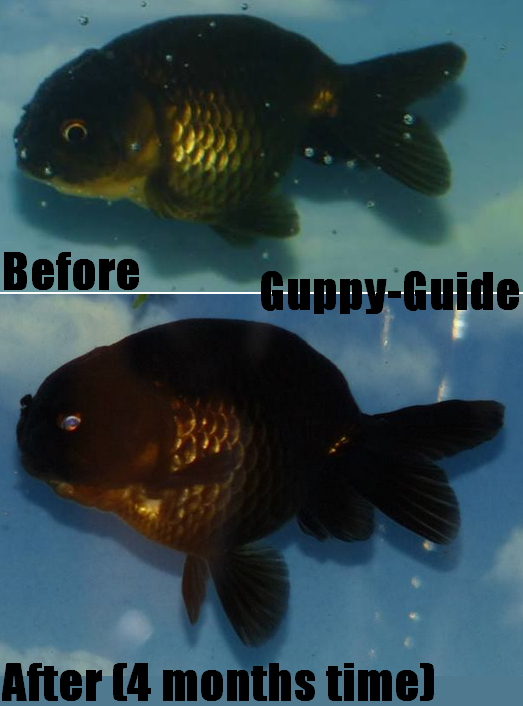
I just wanted to do a quick post to show you how much my ranchu have grown and changed over the course of around 4 months now, and they have definitely gained lots of weight since I first got them (the scales don't lie).
Bumblez (Sakura Ranchu)
Oakki (Black Metallic Ranchu)
According to the breeder these ranchu will be 1 year old (12 months) come March 2014.

12.13.2013

Ranchu Weigh-In

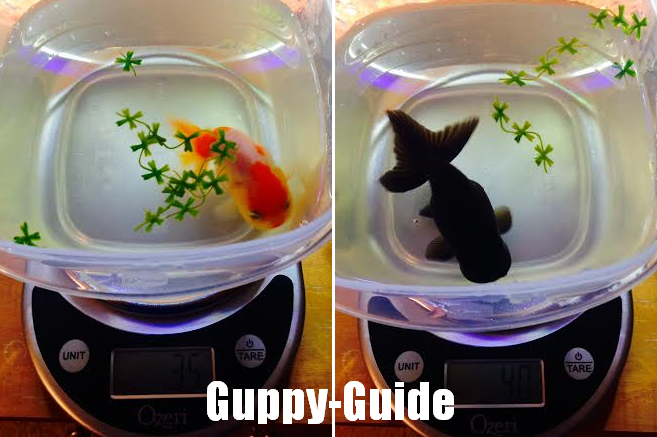
Its been around 23 days since the ranchu's last weigh-in and Bumblez has finally put on some weight at 35 grams now, while Oakki is a whopping 40 grams.
Bumblez (left), and Oakki (right)
Bumblez gained 3.5 grams since the last weigh-in and Oakki gained 6.5 grams. In my opinion most of Oakki's weight/growth seems to be at his belly area and tail length, while Bumblez growth seems to be at his back and possibly a little on his wen. I still do around two 50% water changes at least twice a week, sometimes the depth of the aquarium water varies but I feel they do better at a depth no more than 10 inches (which was recommended to me by the breeder as well).

I've been trying out numerous foods lately and the first week they ate at least twice a day which varied and possibly consisted of some nori, NLS (New Life Spectrum pellets for Goldfish), sliced ginger, Hikari frozen bloodworms, plain cooked white rice, and Hikari Lionhead pellets (just playing with different food options). The second week since I had a fish sitter they were being fed once a day sharing a 1/4 Tsp of the NLS. The 3rd week I got a fish feeder which dispersed NLS gradually over 6 hours, then a few Hikari Lionhead pellets over the following 6 hours, and then the feeding repeated again throughout 24 hours so they're almost constantly able to graze for tid bits of food (which I've read is more natural for ranchu/fancy goldfish) although it's not really going over the amount of food they generally consume in a day.

Having the feeder does seem to make them more active and curious about finding food so I'll probably continue with that regime while also giving them frozen bloodworms 1-2 times a week along with it, and perhaps a little piece nori once a week (Bumblez seems to enjoy that, while Oakki seems to enjoy the daily pellets of Hikari Lionhead).

11.27.2013

Increase Oxygen

Here I've listed 5 simple ways to help increase oxygen levels in an aquarium.

#1 Lower Water Level. Try not to fill your aquarium all the way to the brim with water, as water drops down into the aquarium (waterfall effect) from the filter it forces water down into the aquarium and helps push oxygen into the water thus helping to increase oxygen levels (be sure the current is not too strong for the aquariums inhabitants).

#2 Water Changes. Too many water chemicals and/or waste, etc can cause a loss of oxygen in the water, it's very important to do regular water changes (clean tap water contains adequate amounts of oxygen).

#3 Lower Temperature. Cooler temperatures can hold more oxygen than warmer temperatures but, be sure the aquarium is the proper temperature for the aquariums inhabitants.

#4 Air Diffusers, Bubblers, etc. With these devices attached to an air pump it helps to increase oxygen and water movement in an aquarium.
Air Diffuser

* Bubbles should be tiny (almost pin hole size) looking for the most part, and probably vary in size. The tank should not just have large (about a cm) and/or slow moving bubbles as this may mean your water has become thickened by dirty water. Also be sure your air pump is strong enough to operate the equipment properly, and clean or replace old diffusers, tubing, and check valves as needed.

#5 Filtration. The right amount of filtration is key to keeping a healthy and clean aquarium, you want to make sure the tank is not overstocked with fish either as the fish will be competing for oxygen. Keep filter cartridges clean, and active carbon can help remove unwanted chemicals and aid in oxygen levels.