Showing posts with label Goldfish. Show all posts

8.11.2017

Aquarium Updates and DIY's

Lately, I have had a few aquarium mishaps, the first being that I managed to crush my glass intake tube as I was trying to pull it apart from the tubing. That said, there has to be an easier way to separate those two pieces so if anyone has any tips on that please leave me a comment below and let me know as I have yet to see anything on that topic. Luckily, I didn't manage to cut myself as the tube shattered in my hand (I felt as if I was the Hulk that day) and I had kept the plastic intake tube that came with my canister filter originally so I will now have to use that one in the mean time.
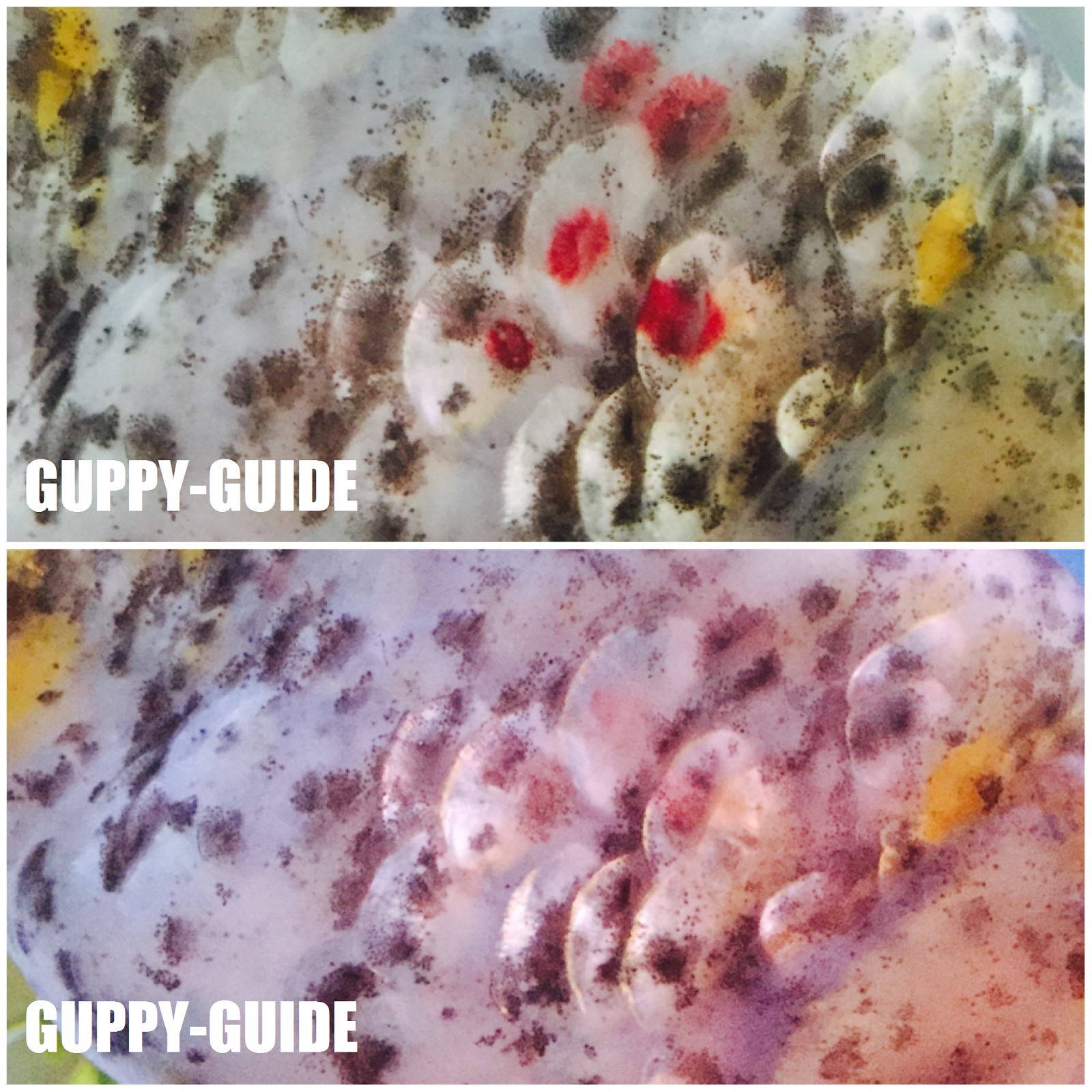
Red spots on Ramen - before (top image) and after (bottom image)
For those of you that don't follow me on IG I have lost 2 of my goldfish recently (Pocky and Ramen) due to some red spot/sore problem (as seen in the photo here). The size of these red sore looking spots would range from half an inch in size to smaller dots, and it was not caused by anything hurting them in the tank. Honestly, I probably could've prolonged their lives by not removing them from my main tank and placing them in 5g buckets for treatment but I didn't want to risk further harming my healthier looking fish and after months of trying to remedy this, I figured it was time to let them go (Ramen was basically stuck on her side for a month and began having trouble eating so, I didn't want to prolong that any longer). I'm not even sure what this is as I haven't been able to find many photos in which to identify this. I believe this may be VHS (Viral Hemorrhagic Septicemia), but I could be wrong as I have never dealt with this before. I tried tons of different medications, etc and I failed with all of them. Whatever this is, it's definitely highly contagious for my goldfish (not sure about other fish as this is just a goldfish tank currently). I noticed when I did my large weekly water changes it often would clear up a bit but over the course of a week it would reappear but the red spots would jump to random places on the body (not really the tail or head area). Sometimes there would be an almost grayish scab that would appear in the center but not always, which you may think is a parasite but I don't believe that was the case (I even dosed with Prazi). Whatever it is I believe to be an internal virus of some kind (I'm not a vet but that's just my best guess) and both fish suffered from Swim Bladder Disease before that occurred.

I am beginning to feel as though fish that end up with Swim Bladder Disease are more susceptible to having secondary issues. Perhaps a weak swim bladder could be a sign of a weak immune system (or SBD weakens a fish in general). It just seems little is known on how to remedy true Swim Bladder Disease without the aid of surgery and the fact it's called a disease makes me want to relate it more to a poor immune system which may have been affected by certain medications, or it could just be a heredity issue. I know some aquarists feel SBD can be remedied with diet change but I feel those results are temporary from my experience, and a major SBD issue won't truly be resolved by diet alone.
Also, I finally got around to trying out my Virkon tablets which are better at killing nasties than bleach and I will say that... it's not that bad. It does have a slight odor to it but I don't find it nearly as offensive as bleach or ammonia. Also, someone mentioned to me that they stopped using this product because it is corrosive, and actually in its powder/tablet form it is corrosive but once you get it to a 1% dilution in water (1 tablet + 1 pint of water) it is no longer considered corrosive (according to the label). Personally, I really like this product thus far as it doesn't seem to leave any residue as with bleach, but I would avoid using it directly on anything metal or electronic just to be on the safe side in terms of corrosiveness (the same can be said for products like Windex). 
Carpet mold from the tank when I started scrubbing it out.
As for my last mishap I learned that if you're using an untreated wood stand of some kind for your aquarium and it has an entirely flat base that rests on your carpet (I was using the top of a wood hutch) than you are basically asking for a mold problem. If any water goes near your carpet, overtime that moisture will creep under the wood base and thus you're very likely to end up with some mold, which was my experience this week. I ended up with some dry black splotchy looking mold and the best way I found to clean up this mess (first dispose of the moldy tank stand and find something better if possible) is to make an ammonia dilution (2 capfuls of ammonia per 1 gallon of water). Using an abrasive brush scrubber you'll than scrub over the carpet in circular motions with the ammonia mixture until the mold coloration removes (or is killed rather) and then you'll repeat this with some clean water. Next use a wet/dry vacuum to suck out the water from the carpet (and its surrounding areas) and then use a fan to help further dry out the area. The carpet may require an additional cleaning after this initial one has had time to dry out as it could still be a bit discolored.

That's all I have to share for this week and I have been super busy lately (hence the lack of posts) but I am working on putting together some new posts before I start back up at University the end of the month so do come by again soon!

1.26.2016

Wen Growth - 4 Tips

When it comes to achieving wen (head) growth on goldfish I feel as if it is some huge secret between goldfish keepers, and most of the research I have found on this topic doesn't seem to be completely true so, I am here to tell you what I find to be the biggest contributing factors to achieving wen growth on goldfish.

1. Temperature
Most people seem to have the impression that higher water temperatures help to set the stage for achieving wen growth, which could be true. Although I have found it is also the lower water temperatures which seem to yield the most changes to wen growth. Also from my research some have said their goldfish get the biggest wen growth in low temperatures around 54F, but I have found you can start getting wen growth results just from reducing your water temperature to 71F.

2. Food
From most of the research I have done a lot of people seem to feel certain foods (or brands of goldfish foods) will yield amazing wen growth results, and even goldfish companies try to promote their foods making them sound as if they are geared toward wen growth, etc. A fish with a healthy diet should thrive in general but in terms of wen growth I found it may be geared more toward the amount of food it's being fed rather than what you're feeding it. Now if you're feeding your fish a lot it's basically going to grow bigger at a more rapid rate, but this is more related to its body size and not its wen growth. I found feeding a goldfish less may allow the fishes body to not grow as fast at a more rapid rate and instead the nutrients of the food may actually go to contributing to the fishes wen growth. This may be another reason why one would see more rapid wen growth in colder temperatures as well because colder temperatures make goldfish slow down their activity level and they ultimately begin to eat less. So if you want your goldfish to have good body and wen growth, try using a quality goldfish food and finding/calculating the right amount to feed them while keeping the temperature and their activity levels in mind.

3. Genetics/Breeding
A lot of goldfish may seem to never achieve much (if any) wen growth and I find this could be more related to the fish's genetics and probably poor breeding standards to some extent. If you buy a small young colored up goldfish and it looks as if it really has no wen growth coming in currently than don't expect as your goldfish grows up that it will achieve any, because I have found more often than not it just won't really. If you want a goldfish with big wen growth, I would suggest looking for a goldfish that currently has some good wen growth coming in before you decide to raise that fish thinking that it will achieve wen growth as it grows.

4. Health
If you have a fish suffering from things like Swim Bladder Disease or some underlying issue (again certain problems could relate back to genetics/breeding), this could possibly be a reason why you aren't seeing any significant wen growth happening (although an excess amount of wen growth could actually become problematic for goldfish as well). Again, this can relate back to also providing the fish with a healthy diet. Another part of a fish's health is having a clean habitat, most serious goldfish keepers tend to do rather large water changes, either doing them daily or weekly is what seems to be the norm. If you aren't sure when to do your water changes at least test your aquarium water weekly and see what your water stats are, in doing this it can help give you the knowledge you need to keep your aquarium healthy and provide your goldfish with the best habitat for achieving things like wen growth.

3.26.2015

Best Fake Plants for Fancy Goldfish

From my experience with fancy goldfish they do seem a little picky about what fake plants they take an interest/liking in. Mine seem to go for more colorful varieties such as those that are pink, rather than the more realistic green plants. For mine the below fuchsia colored plant seems to attract their interest the most thus far as they'll swim by and occasionally try to nibble at its leaves.
National Geographic flower plant @ PetSmart
When I asked others what type of fake plant/s they felt were best suited for fancy goldfish the most common response was along the lines of.. "silk plants" as to prevent goldfish injuries (so avoid fake plants that look spiky). Another person suggested low/short plants with really big leaves, they claim it helps catch food which goldfish will eat later. Also fancy goldfish can be a bit clumsy at times so I'd suggest that the fake plant has a wide and weighted base as to help prevent the plant from tipping over. Based on everything here I put together the below image of the types of fake plants which fancy goldfish may like best (these are all from Petco, PetSmart, and PetMountain).

What type of fake plants do your fancy goldfish like?

3.11.2015

Lionhead Progress (6th Month)

This month I mainly fed the lionhead (or as I have been told they are ranchu not lionhead.. or lionchu, whichever you feel these fish are) Saki-Hikari fancy goldfish (green bag) which has consisted of 3 feedings a day and 1/8 tsp per feeding (which is a lot less than these fish were eating the previous month). I also spent the month researching, designing, doing water changes (which is much easier now with a pond pump), etc to figure out why Pocky and Ramen both appeared to be having sudden swim bladder issues most the month. I figure the issue was due to escalated nitrate levels (which you may have read about correcting nitrate levels in my previous post) because after I did several big water changes the two fish appeared to make a quick recovery within 2-3 days (although some days they still seem to have issues), and the nitrates were really the only thing off when I tested the tank water (why we are often told to neglect our nitrate levels is now beyond me).
Sumo, Ramen, and Pocky (left to right)
My little Sumo currently weighed the most for a second month in a row now at 77g, which is a 10g gain from last month. Ramen weighed in at 72g with a 13g gain from last month allowing him to put on the most weight this month, surpass Pocky in weight, and have the average weight between the three. Pocky whom was the fastest growing of the three just 2 months ago only weighed in at 68g with a tiny 2g gain from last month (what's up with that??).
Click to Enlarge
The average gain this month was 8g (0.3g daily) which is half of what it was last month, keeping in mind that I did halve their food intake this month. As usual while the food was halved the weight of fish was not divided equally, although I am surprised to see Pocky falling drastically behind. Pocky has had a rough month in terms of swim bladder issues (same for Ramen though), but it could also be he doesn't care for the new Saki-Hikari as much as the others (because both Pocky and Sumo practically weighed the same last month while Ramen was tailing behind).

Based on my findings from this month and last month this shows me how much weight will be gained by my fish as a group, since half the amount of food is also half the amount of weight gained as a whole. I also feel that each fish has better weight gain depending upon their favored pellet food, I don't think it's one type of pellet food that really works for all the same type of fish. Also by halving their food intake Ramen and Pocky both noticeably were having some type of swim bladder/equilibrium issues, is this affected by high nitrate levels only or perhaps is this some type of hunger pain issue?

For next month I am going to go back to feeding the lionhead 1/4tsp of pellets per feeding, and I am going to put them back on a mixed pellet diet. I will also insure my nitrate stay at 40ppm or lower on a weekly basis. Since my fish are getting rather big for my tank setup I do plan to remove the large barnacle decor in the tank ('Eval' the pleco won't be happy about it) and I will probably just add in some fake plants (doing this will give the lionhead more swimming room as this currently takes up around 1/4 the tanks length, and it will increase water volume).

12.01.2014

Who's the New Fish?

It's Pocky!
Recently one of my lionhead goldfish starting going through a dramatic change which happened in under 2 weeks (mostly within a week).
Before and After
My fastest growing lionhead 'Pocky' has rapidly lost his orange coloring. Overall Pocky's behavior has not changed and none of the other lionheads have yet to show any dramatic color changes. I can not pin-point the exact cause of Pocky's change although it could be due to... a lack of light (so I started leaving the light on at night where-as before I didn't really use it), low acidic pH (I have fairly high pH at 7.4+ which makes my water alkaline), food (I had started mixing in OmegaOne pellets last month which could be a possible cause), disease (so I treated the tank as a preventative), or age (I have had these lionhead for under 3 months now).
Before and After (mid transformation)
Whatever the case may be.. at least it is easier to distinguish Pocky from Sumo currently as it's almost like I have an entirely new fish. The little bit of orange that is currently left on Pocky is still rapidly disappearing so, we shall see what happens with Pocky over the next few weeks but I honestly feel this may only be age or gene related (which may perhaps mean that one of Pocky's parents was of the lemonhead variety, and if that's the case I believe Sumo is its sibling so I would perhaps anticipate Sumo changing colors as well). 

11.26.2014

Goldfish in Vegas

Click to Enlarge
While in Las Vegas, NV this year I ventured into none-other than Caesars Palace (hotel and casino) and went by the Beijing Noodle No. 9 restaurant. First off, Caesars has pretty much always had big elaborate aquatic setups throughout but I was surprised to find a goldfish setup this time around.
All the goldfish appeared to be red fantails.
The tanks had no decor inside but on outside you can see chain curtains separating the tanks (I believe there were 2 rows of 6 tanks total), mirrors throughout, and the filigree design coming into the background on some of the tanks.
The filtration for these tanks appeared to have built-in mirrored filter boxes centered within the tanks themselves where the water appeared to flow under the box, which probably went into a hidden filtration system down into the white contemporary aquarium stands. Thus the water would then be pushed back up through the top of the box (not sure why they didn't try to hide the black outtake hoses).

11.04.2014

Hikari Lionhead - Review

I have been using the Hikari Lionhead pellets on my fancy goldfish for around a year now on various goldfish and I just wanted to give a quick review on what I think about this fish food.
Size
These Hikari Lionhead pellets are relatively big as they're around 1mm in size, and one of these pellets equals about 4-6 pellets of 'New Life Spectrum for Goldfish' so, you probably wouldn't want to use these for fry/young goldfish, or small mouthed/throat-ed fish. Also these pellets tend to dissolve pretty quick in water, if left uneaten they will basically expand to about 2-3 times their originally size in the water and thus dirty your water pretty quick overtime.

Smell
I noticed that these pellets have a very strong smell and can easily stink up an indoor aquarium. That being said I'd say these are more ideal to use for outdoor ponds because it can smell up a room in your house through the aquarium water. For myself, I'd only feed this as a small treat once in awhile if kept indoors, or in small quantities with other pellet food daily.

Fecal Matter
These can possibly make your fish have thicker fecal matter, and generally the fecal matter is very dark brown in color when only fed this so, I do worry about constipation becoming an issue. This could perhaps be beneficial for awhile if your fish is perhaps having very stringy looking poop.

Head Growth
I really haven't noticed an increase in head growth and such with this, but based on how my fish look and other fish I've seen that eat this it seems to possibly help develop a higher arched back closest to the head of the fish (although the higher backs may come with age and eating in general more so than with this food).

Taste
Some goldfish may not be overly into this food as one of my ranchu appeared to like it more than the other, and the one that liked it the most had grown to be about 10 grams bigger than the one that didn't. Which could perhaps be useful if you're trying to quickly grow out certain goldfish.

Overall
I did not find my fancy goldfish had gained any real head growth from consuming this product over the course of several months, which was the main reason I bought this to begin with. Feeding this as a daily diet would also not work for myself as the food has too strong of a smell for indoor use in my opinion, and I worry about fish constipation with this product. On a scale of 1 to 5 I might give this a 3 at best.

9.19.2014

New Lionhead Goldfish

Introducing my new lionhead!! Ramen (blue calica sakura) because he is just one big mash up of goodness and who doesn't love Ramen?!!; Pocky (middle sized) because of his little pockets and Japanese inspired foods seemed to be my theme; and... the smallest one is Sumo because he tends to be a bit of a brute "although I am but tiny I am mighty".
The little lionheads (estimated to be 1.5 inches in length) had their first weigh-in the day after pigging out on frozen bloodworms the night I got them. The smallest lionhead was at 4 grams, the middle at 5 grams, and the biggest at 6 grams. Based on my ranchu's growth rates vs. age I can hopefully assume that when these lionhead average 30g they will be close to 5 months in age, but I feel like they should be near that weight in a month or two since I believe they develop their colors right before 4 months of age. I do feel like my lionhead may be very underweight if that's the case but we'll see how much weight they put on over the next few weeks.
Unfortunately most US pet stores do not often take the best care of their fish and I found these fish do currently have a few imperfections. The gray looking lionhead I believe to be a blue calico sakura appears to have damage to a pelvic fin as it looks stumpy (I don't believe this will affect his overall health as some fancy goldfish may only be born with one or no pelvic fin/s but generally they have 2), but this lil fishy is the most friendly of the 3 here and is definitely a lil piggy at meal time. The two orange, red and white lionheads are shy and currently very pushy, but I am hoping with scheduled feedings and such that they will become more gentle. The smallest of lionhead is probably the nicest looking in terms of body shape but often sits at a bit of an angle (much like my ranchu Bumblez did). All these fish currently have fin splits on all their fins (probably due to rapid water parameter changes) so I am dosing the tank water with some API Melafix to hopefully help speed the fin repair along, and I should hopefully see results over the next 2 weeks.

11.09.2013

Aqueon QuietFlow 30 Power Filter - Review

There wasn't a free thermometer BTW.
Having recently purchased the Fluval AquaClear 50 power filter after reading all the rave reviews online, I found that after I observed the unit for myself that it wasn't going to be good for cleaning my aquarium. So, I exchanged the AquaClear for the Aqueon QuietFlow 30 because I do really like the Aqueon QuietFlow 20 and the 30 is around $10 less than the AquaClear and does the same GPH (Gallons Per Hour) although it doesn't have all the media things that the AquaClear has (the design of the AquaClear doesn't force water through all the media anyway, thus rendering all that media practically useless and even more costly with long term use in mind). If I had to recommend a Fluval power filter to try out I'd go with the Fluval C3 (although it only does 153 GPH and seems to be slightly pricier than its AquaClear cousin) because water is forced through all the media unlike with the AquaClear power filters, which makes the C-series seem more similar to QuietFlow's in that aspect(although the Fluval C-series appears more annoyingly complex in my opinion).
Aqueon QuietFlow 30 Power Filter and 'Large' carbon media cartridge
As for size difference with the Aqueon QuietFlow30 compared to the 20, the intake tube appears to be exactly the same in size, the box is around 1in longer and maybe 2mm wider, and the motor is also longer by about an inch. The 20 and bigger sized power filters all take the "Large" size cartridge's although the 90 takes 2 of the cartridges so, it's really only the GPH that changes between the 20 and 30. The 50 is slightly bigger than the 30 (as expected), but the intake tube changes to a wider tube with a longer vent area. A downfall I recently noticed is that the fan inside the motor (which is directly above the intake tube) can't be easily removed for cleaning so, if you have fish with a big bio-load (like goldfish) than you may find the buildup to block the fan from functioning (thus this filter will be rendered useless until fixed/cleaned).

As you can see from the above photos the media cartridge does not contain that much carbon (probably its biggest downfall if you're a carbon addict). The media box of the 30 does change compared to the 20 as it has some slats where the water first comes into the box from the intake tube (not sure the true reason for that), and thus far I do find the unit nosier than the 20 but also much more powerful (so it only makes sense I suppose that it would be nosier). There is also some room in the box if you wanted to add in some additional media.
The QuietFlow 30 with a Fluval pre-filter attached
As for extra's I put onto my Aqueon QuietFlow 30 I added on the Fluval Edge pre-filter sponge (fairly inexpensive and I like the soft texture of these ones) which fits perfects on the 20 and 30 (this pre-filter would be too small for the 50 and up, and I think the 10 also has the same size intake tube as the 20 and 30). The intake tubes are also adjustable by sliding the adjoining tubes up or down, the picture above shows it at its shortest length (I don't really care for the tubes longest possible length as it gets too wobbly for my preference).

Overall, I do recommend the Aqueon QuietFlow power filters, they work great compared to other LPS (Local Pet Store) HOB power filters I've tried in the past as they're pretty decent at cleaning. I reuse the cartridges for months at a time as they're pretty durable with weekly cleanings (thus saving money on cartridges in the long run). These aren't overly noisy although sometimes the filter cover on top tends to vibrate a bit (but with a little adjusting on occasion it stops). I also like how the cord tucks into the side of the unit and also how the motor is in the water and not outside the box (no having to worry about leaks or priming it with water to start up). The blue waterfall piece can be removed easily and cleaned, it allows water to drip down onto the waterfall bridge and it's pretty helpful at catching bigger debris (which I think is nice for those with planted tanks). One draw back I think may be an issue is the width of the unit in the tank, it seems to be too wide for a lot of aquarium hoods/tops (but since I only have a glass top I just pull it forward a bit to accommodate the unit, doesn't really bother me). I'd suggest the 30 for tanks bigger than 10-gal (as it made my 10-gal pretty darn turbulent) as it's probably better suited for a minimum of 20-gal, and it claims to also work for saltwater aquariums as well (if you do have a saltwater aquarium I'd recommend getting at least the 30 or higher models), and the 20 works fine for a 10-gal.

9.23.2013

Treating Ich on Ranchu

This past week I made a big mistake thinking that my ranchu would be fine in a temporary bucket of water while I cleaned out the aquarium. Well, it took me awhile to get around to actually cleaning my tank so I transferred my ranchu into a new bucket of water and they ended up going through a drastic temperature change (ranchu can only handle around a 3-5F temperature change at time) and thus suffered from it. Bumblez is not at all a fan of cold water and thus he began slowing down his swimming, while Oakki had broke-out in ich on the front of his wen. Luckily I was able to remedy both of them at the same time, here's how I cured and treated the ich in under 3 days (be sure to treat ich ASAP)...

1: Do at least a 50% water change to the aquarium water (be sure the new water added in is within 3-5F of the current tank water temperature), and treat the water with Seachem Prime according to directions (Seachem Prime helps reduce stress, helps slime coating, and dechlorinates water).

2: Keep the water temp in the aquarium around 74-76F (I use an Aqueon heater), as this seems to be an ideal temperature for ranchu in general.

3: Add 1-TBSP of Aquarium Salt (I used the Jungle brand) per 8-10 gallons of water (aquarium salt reduces stress, provides electrolytes, and cleans.. it may also raise your pH so be sure to dose accordingly). Although it may not be necessary, I added in a pinch of aquarium salt everyday after this initial dose until my ranchu no longer showed signs of ich.

4: Turn off any aquarium lighting to reduce any stress caused by glare, etc as these fish have already undergone enough stress at this point.

5: Be sure to run an air diffuser in your aquarium (along with a 24/hr running filtration system) for at least several hours a day to insure the fish are getting plenty of oxygen in the water (this is very important if you are using any other water treatments to remedy your fish outside of what I have on this post), this is especially important for smaller aquariums and/or ones with a higher temperature.

I hope my ranchu ich remedy works for others just as well as it did for my ranchu, and be sure to do another 50% water change a few days after having done the first one as to reduce the risk of having ich spread, etc (just be sure the new water you're adding into your aquarium is in the ideal temperature range as I mentioned before, too drastic a change may only worsen or cause the ich to reoccur). Good/adequate water quality can solve a lot of problems (be sure ammonia levels are also in a safe range, preferably no traces of ammonia, this is especially important if you have a small or overcrowded aquarium).

9.15.2013

Ranchu Artwork

My awesome new artsy friend Chris made me this cool drawing of Bumblez (my new sakura ranchu) the other day and I totally love this so, I just had to take a moment to share it with everyone on here!
"BLUH?"
If you want to checkout more of his work, etc you can find him at www.ChrisSpade.com.

9.06.2013

East Coast Ranchu - Review

For a really long time now I had been wanting a ranchu and looking all over my local pet stores in hopes of coming across any. I really didn't have much luck and I did actually see what I believed to have been ranchu at a Walmart one night but... it was bad timing, I was worried about the quality of the fish, and so... I missed my chance. I even sent out e-mails to fish stores within a state or so of me since I burnt out all my options locally in the DC area, and either I didn't get any response or I got weird rude replies back.

It wasn't until I went searching again on eBay that I looked into eSeller eastcoastranchu. Turned out these 'side-view' ranchu are bred in New Jersey by a very kind and patient lady named Cynthia of East Coast Ranchu. I also found that East Coast Ranchu donates 10% of their earnings to GoldfishKeepers, and if you buy 5 or more ranchu's you can get 10% off. As you may have seen from a previous post I did on here she made a video of several ranchu for me after I told her the type of ranchu characteristics I was looking for. I ended up picking the one that stood out from the lot and got the cute red-capped sakura ranchu whom is even cuter in person. I did get the 2-day shipping and my poor fish ended up spending so much unnecessary time in its box going from NJ to lower VA, and VA to MD, and then they spent a good 9-hours of delivery time when I was only an hour away from the UPS location. Then my package finally arrived right before I had to leave for work that night (watch my video below to find out what happened next!).
Here's my adorable new pet ranchu's Bumblez and Oakki after a week of them settling into their new home!
Bumblez
Oakki
I will be doing another post in the near future on how I care for my new pet ranchu's.

8.25.2013

My Ranchu - Coming Soon!

Recently I got to talk with the wonderfully kind Cynthia from East Coast Ranchu online about getting my first ever ranchu goldfish! I have been wanting a ranchu for like 13423534 years now (okay, that was a slight exaggeration) and I have done much research over the years on them (you should never get a new pet without having done some research BTW).

Cynthia was kind enough to make me a video of some fish she thought I'd be interested in per what I was looking for in a ranchu... now the only problem I faced was picking just 1 of these cute side-view sakura ranchu (so hard to choose when they're all super adorable). Can you guess which one I ended up picking?

One ranchu cost me $53.40 (included 2-day shipping to my location, etc), whoever thought freshwater fish were cheap was sadly mistaken. Mean while I have already been working on getting my ranchu aquarium setup, Cynthia also sent me a list of my fishes needs/requirements/etc so that definitely gave me a bit more helpful incite. Having had a few comets many years ago also helped remind me of what a goldfish's needs are and the things I know now which can better prepare me for my ranchu. I will also be doing a fairly elaborate post of my ranchu aquarium setup very soon.

10.27.2012

Aquarium Finds & Updates

I just saw that Nat Geo Wild has an aquarium show called 'Fish Tank Kings' which is basically like Animal Planets show 'Tanked'. I'm still wishing for a show that specializes in freshwater aquariums, and talks more about the aquatic life in the aquarium and such. In the mean time... 'River Monsters' still ranks as my fave fish show to watch.

Other news... one of my breeding guppy males 'Cheeky' passed away a few days ago, I noticed he was becoming inactive over the past week or so... it was really only a matter of time before he passed since I couldn't identify his condition. I'm not sure if 'Freckles' got pregnant from him or not but the two baby guppies I had found in my tank after giving away my fish appear to be a male and a female so... he will become the young females mate and 'Freckles' new mate in the future if all goes right. I'm also not sure if 'Blue' has impregnated 'Quartz' yet either. On that note, I'm going to have to name them both at some point!

I also wanted to share the recent overstocked, sick, mistreated, etc fish at my local Walmart this week. I think I'm going to periodically try and share these poor living conditions of fish because I don't think it's right for things like this to be acceptable in pet-stores/dealers and I'm trying to get people involved in what I call 'fish rights' because all these other pets (such as cats and dogs) undergo a certain process upon purchase and have rights, etc so, I think that's only fair.
In the first photo on my trip to Walmart's aquatic department you'll see a ton of Oscars all kept in a small tank and also how their are some small fancy goldfish such as Oranda's in the tank with them. First of all Goldfish shouldn't be kept with Oscars because Goldfish aren't tropical fish. Also, Oscars are aggressive fish that acquire a large habitat to live in and Oscars will even attack each other. So, as you can see the Oscars were eating the Goldfish, several Oscars managed to get the entire Goldfish inside them whole... Goldfish tails sticking out of their mouth and some of them still moving after being spit out in the Oscars attempt at eating the Goldfish alive.
Next you'll see a Walmart Goldfish, a case of bad fish care, and having been subject to some fish cruelty (also, yet another case of an overstocked small aquarium). This fish seemed to be swimming around fine and healthy although missing its top fin, the wound did seem healed although the fish will have to live with its handicap. Just out of curiosity but is their anyone out there that cares or collects injured fish because they are truly special and unique, and of course deserve a safe happy life?
Betta's with very low and poor quality water (why does it vary in colors?). I was almost tempted to grab a jug of spring water down the grocery isle and fill these up, eheh. Have you noticed that a lot if not all Walmart's got rid of their sink area in the fish dept?

12.31.2010

Maguro's Life Story

I purchased an adorable redcap oranda from PETCO and although it is cute and spunky when I bought it...I did notice it is not in perfect health.
Hello my name's Maguro...yes, it does mean tuna in Japanese.
My cute little friend here seems to have a yucky case of fin rot. Not only are its fins tattered, but it seems to have some black fungus covering the edges. If I can't get the fins to improve within two weeks it may get returned to PETCO because when fins continue to rot and lose more and more growth...eventually the fish will not have a tail and will more than likely not survive. It also appears to not have perfect looking scales, not sure if these were removed or something else, but hopefully it can build up a better slime coat by using the proper water conditioner.
My owner took me to a sushi restaurant during our first day together...she thinks I look like maguro nigiri, hence my name Maguro.
Also, I have never owned a goldfish like this (comet's yes, oranda's no) and I am beginning to wonder if it has a heart condition or this is normal behavior... I will see its gills move in and out, it swims about a bit and then it decides to stop...its gills stop moving and it remains motionless at the bottom (still right-side up of course). Its gills then start moving again and it swims about after seconds of being motionless (which feels like minutes at times)...or could it be sleep apnea?

I will keep this post updated with an "after" photo within two weeks time (or less).
Click image to enlarge
Day 1- Added my tap water with Maguro's petstore water (added random chemicals to test how fish would respond). Maguro had eaten a little flake food but did not seem to be a fan of brine shrimp.

Day 2- Changed out all Maguro's water with my tap water (added random chemicals to test how fish would respond). Maguro did not eat any food.

Day 3- Soaked Maguro in clean tap water with Jungle Clear Water (active ingredient: potassium permanganate) for 30 minutes. Solution: 5cups Water mixed with 1/4tsp Jungle Clear Water. However, after doing the soak for the first time I'd only recommend to leave the fish in the solutuion no longer then 15-20 minutes, then remove the fish from this soak and move onto the next step here (during the soak was the most active I had seen Maguro since I got him). Next I mixed together 1/8tsp MelaFix, 1/8tsp PimaFix, 1/4tsp Tetra AquaSafe and 9cups of clean tap water (I will do this treatment again tomorrow for its water change). I crushed up a little flake food and Maguro ate a bit of that, Maguro did not seem to care much for algae wafers.

Day 4- Today Maguro was his most active-self thus far, he was eatting and swimming around more, even after the water change today. I did notice a few white flecs (looked similar to dust really) on Maguro's wen yesterday, was wondering if it might have been a bit of white spot but I couldn't really see it today so it may have cleared from the treatment already. I do think Maguro may have some constipation so I will probably feed it a grain of epsom salt during its water change tomorrow. I also purchased some Aqueon Color Enhancing Goldfish Granules today along with Aquarium Pharmaceuticals Aquarium Salt which is said to help clear numerous ailments for goldfish (1/2TSP of API Aquarium Salt per 1 Gallon of Water for Goldfish).
Click image to enlarge
Day 5- I actually caught Maguro going to the surface of the water this afternoon, several times in fact, since he had only been staying at the bottom of the bowl. He does not seem to stop breathing anymore like before. Maguro is also eatting EVERYTHING (Algae Wafers, Flakes and Granules)...including his own poop (disgusting I know), so I decided to give him a bit more food then I had been. I made a gallon of water with 1/2tsp of aquarium salt and a 1/2tsp AquaSafe, I then added 5cups of the mix to a bowl with 3/4tsp of Jungle Clear Water and left Maguro in there for 15minutes. However, the salt in this mix seems to absorb the Jungle Clear Water and turns it tea colored instead of purple colored like before so I do not think the salt is an effective combination this time. I then placed Maguro with 10cups of clean Aquarium Salt mix with 1/8tsp MilaFix and PimaFix.
Click image to enlarge
I also fed Maguro a tiny grain of epsom salt today, which was a little challenge all its own. First I had to lift Maguro out of the water, next I had to cover one of its eyes with my finger (everytime my hand moved in to place the salt into his mouth he'd close his mouth). So once the eye was covered I brought my hand around and was able to wiggle the salt into his mouth and dropped in a few drops of water to make sure the salt went down (as it'd stick to his lips and come back out).

Day 8- Maguro was seeming to get better until today, for some reason all he wanted to do was float around and do the back stroke while blowing bubbles at the waters surface. The black fungus on his tail has maybe gotten a little less dark due to all the Aquarium Salt water changes which I have been doing over the past few days regularly, but it's really hard to tell though to be honest. I personally think Maguro has gained a little weight and his wen seems bigger to me. I do think his tattered fins have been mending a bit and becoming less jagged and more rounded. Although I fear something internally is harming him today and I am not even sure he may live past today or the next few days. He is currently undergoing a Marcyn Two water treatment for today.

Day 9- Maguro is still alive! Apparently I may have fed him a bit too much flakes and brine shrimp yesterday and he took in too much air thus causing him to float upside down a bit while blowing out bubbles. He was well and normal this morning. However, I am concerned about the black fungus because it seems to have gone onto the tip of his dorsal now, even though it doesn't seem to have spread elsewhere on him. At this rate I am beginning to think to just move him into a tank by himself rather than the 10cup bowl I have been quarantining him in, perhaps less stress of daily water changes and chemicals may be more effective then what I have been doing to treat the black fin rot fungus.

I also did more research on the fungus which says...
In general, fin rot occurs when the fish is stressed. The most common cause is...

-Poor water quality (which couldn't be the cause for it getting worse since I change it everyday)
-Overfeeding
-Overcrowded environment
-Handling of your fish

To help prevent fin rot, make sure you...
-Do water changes every week (have been doing daily)
-Test the water (to make sure all is ok) (water is fine)
-Try not to over feed
-A little bit of stress coat should help keep out bacteria and allow electrolites from being lost (Instead of a treatment type med)

If there are red streaks or fuzz growing on the affected areas, then you can treat for baterial or fungal infection. Otherwise, just keep nitrates low. Sometimes these things may have permanent damage so if the slits don't fuse back, but don't become infected then don't worry.

So this means that I need to monitor his food intake, use stress coat rather than treatments, provide it with more swimming room and less handling of my fish. So yes as I stated before Mag's will be moved into a 10gal aquarium to see if he makes any progress. For more tips and advice on treatments checkout the link, I will also try raising the water temp in the new tank environment.
Perhaps an inner parasitic infection causing the sunk-in appearance and red spots.
Day 10- No Maguro isn't dead, this is just one of his recent tricks...err problems. Second time that I have cleaned his water that he decides to turn sideways or upside down but later on he goes back to normal. Not to mention he hasn't seemed to have eatten in the last few days. I think the black fin rot doesn't seem as dark as it was although it is still present as you can see. He also has some other black fungus on his wen now along with ick yet again.

Day 11- Marguro seems practically dead today, he has been laying on his side again since this morning on top the water, all limp bodied and barely if at all breathing and hasn't ate in days. At this point I don't think there is much else to do accept say goodbye to Mags, return him back to the store and hopefully get a refund. R.I.P. lil fishy.