11.09.2014

Free... Water?

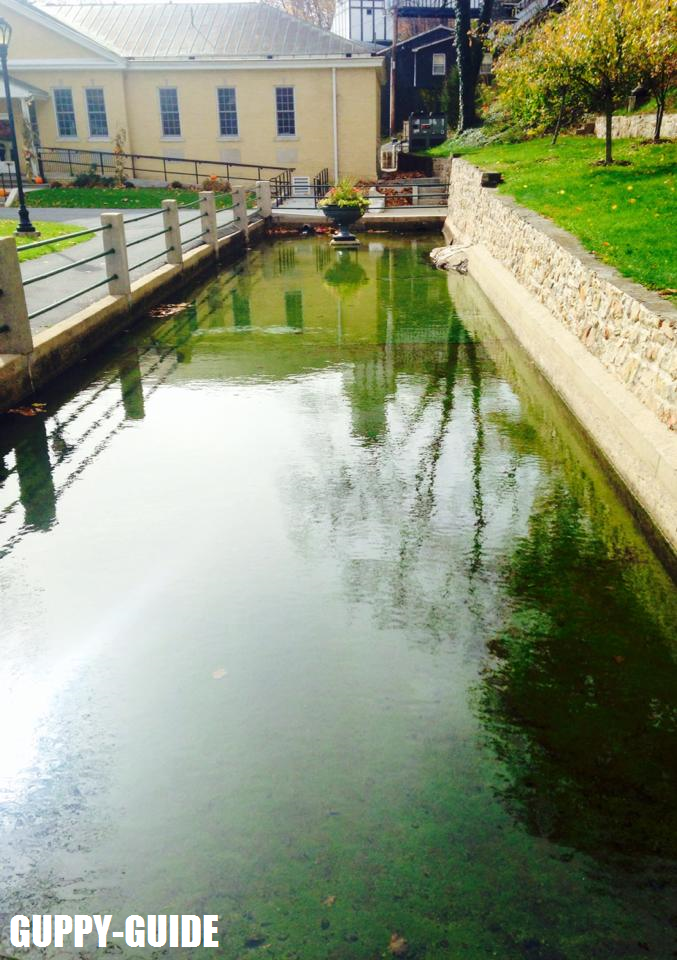
This week I discovered an interesting local treasure about an hour away from my place. Located in Berkeley Springs, WV lies what is known as George Washington's bathtub.. which was apparently his favorite spot to bathe. Not only does there appear to be what looks like guppies swimming in this outdoor area (I think you can actually fish them out with a net as the museum gift shop sells fish nets) but there is also free water available coming from two different outdoor units. This water also gets filtered 1,000 times per minute.. which puts most any hobbyist aquarium filter to shame (hah). Upon talking to a few other people one lady from Bethesda, MD actual drives nearly 2 hours to fill several 5 gallon jugs (she does this every 2 months) of this natural spring water, and I mean who doesn't like free water? Okay okay.. if you come here before 5pm and it isn't a Sunday or holiday than you will possibly spend $0.25 to pay the meter to park long enough to get some of this water... otherwise it's free (and there really wasn't any lines to get this).
Berkeley Springs, WV
So, I quickly had the idea of dumping out a perfectly fine small bottle of Deer Park water to refill it with this water which seemed to be considered "special" by its regulars (so maybe they're a bit on the "hippie" side, hehe). I took a drink and although the water wasn't cold (and it didn't immediately kill me) and it did have a very slight smell, I knew my main reason for taking it was to actually test the quality of water using my API water test strips back home (and yes, I have fish on the brain, haha). The test strip readings came back as the following...

NO3 (Nitrate): 1 (est.) Safe
NO2 (Nitrite): 0 Safe
GH (Hardness): 150 Hard
Cl (Chlorine): 0 Safe
KH (Alkalinity): 120 Ideal
pH (Potential of Hydrogen): 7.0 Neutral
Temperature: 74°F/23°C

After these test results I had my lovely assistant Meko (my betta fish) take a sip... and he's still doing fine. Honestly I'm not sure what would be "super" about this water after seeing these results, but it obviously has minerals in it based on it being 'Hard', which I know all too well that hard water generally adds annoying mineral deposits onto aquarium surfaces. I actually think what I am smelling in this water may be Iodine which is generally used in outdoor hand pump type water devices (which in this decade you may have seen around camp/hike sites), and Iodine is not something that everyone should consume (such as those with overactive thyroids) but I have heard crustacean types often require a bit of this to keep their shells hardened. Upon taking an up-close look at the clear water it does appear to have a few very tiny/fine dust-like looking particles floating about. The most interesting thing to myself about this water test was probably the fact the nitrate readings are barely existent from this fresh spring water, but perhaps it's due to the water being filtered 1000 times per minute. Another interesting thing about this water is that it runs around 74 degrees Fahrenheit (I am assuming that's year round based upon nearby signs), which may be how a scant amount of guppies are capable of surviving in these waters (which I am also curious about acquiring a few of these fish in the future) as I am not sure how well they would survive in freezing temperatures.
11.04.2014

Hikari Lionhead - Review

I have been using the Hikari Lionhead pellets on my fancy goldfish for around a year now on various goldfish and I just wanted to give a quick review on what I think about this fish food.
Size
These Hikari Lionhead pellets are relatively big as they're around 1mm in size, and one of these pellets equals about 4-6 pellets of 'New Life Spectrum for Goldfish' so, you probably wouldn't want to use these for fry/young goldfish, or small mouthed/throat-ed fish. Also these pellets tend to dissolve pretty quick in water, if left uneaten they will basically expand to about 2-3 times their originally size in the water and thus dirty your water pretty quick overtime.

Smell
I noticed that these pellets have a very strong smell and can easily stink up an indoor aquarium. That being said I'd say these are more ideal to use for outdoor ponds because it can smell up a room in your house through the aquarium water. For myself, I'd only feed this as a small treat once in awhile if kept indoors, or in small quantities with other pellet food daily.

Fecal Matter
These can possibly make your fish have thicker fecal matter, and generally the fecal matter is very dark brown in color when only fed this so, I do worry about constipation becoming an issue. This could perhaps be beneficial for awhile if your fish is perhaps having very stringy looking poop.

Head Growth
I really haven't noticed an increase in head growth and such with this, but based on how my fish look and other fish I've seen that eat this it seems to possibly help develop a higher arched back closest to the head of the fish (although the higher backs may come with age and eating in general more so than with this food).

Taste
Some goldfish may not be overly into this food as one of my ranchu appeared to like it more than the other, and the one that liked it the most had grown to be about 10 grams bigger than the one that didn't. Which could perhaps be useful if you're trying to quickly grow out certain goldfish.

Overall
I did not find my fancy goldfish had gained any real head growth from consuming this product over the course of several months, which was the main reason I bought this to begin with. Feeding this as a daily diet would also not work for myself as the food has too strong of a smell for indoor use in my opinion, and I worry about fish constipation with this product. On a scale of 1 to 5 I might give this a 3 at best.

10.16.2014

Bristlenose Pleco - Diet

My Bristlenose Pleco "Eval"
TetraVeggie-Tropical Algae Wafers (Wal-Mart for $3.79)
My bristlenose pleco (whom I have had for several years now) seems to love TetraVeggie algae wafers. I've had guppies and goldfish also nibble away on this. I usually drop in half a wafer in my tank every other day (not daily because I still want my pleco to keep any possible algae growth obsolete).

Cucumber and Squash
To prepare cucumber I start by washing the cucumber off in hot water (you can go the organic route if you prefer to be on the safe side), peel off the outer skin (as the skin tends to go uneaten),  slice the cucumber in 1/2in thick cuts (or you can slice it long ways) and try to pick off any seeds, and then soak the cucumber in a container of water in the fridge for several hours (this helps the cucumber slice sink to the bottom). Or you can boil the slices which may soften the vegetable quicker and allow the fish to more easily eat it. A single slice can generally feed a bristlenose for a good week (although you may want to remove the slice after several hours as to not pollute the tank).

Brown and Green Algae
This generally occurs naturally in an aquarium with too much lighting (the reason I bought my pleco to begin with) and my pleco is always in search of this as she is consistently cleaning (and she does a great job of keeping the algae at bay).

Pellet Food
I have recently found that bristlenose may be attracted to certain pellet foods as mine has recently been seen eating some OmegaOne goldfish pellets which I recently purchased, so perhaps there's an ingredient in certain pellet foods which attracts them as my bristlenose does not go for my tanks usual goldfish pellet food (NLS).

Side Notes: Among other things I have read people feed bristlenose frozen bloodworms, but I have never seen her eat that or show any interest in them. I also find not all algae wafers seem to interest algae bottom feeders. Some say bristlenose need driftwood in the tank to help their digestive system and provide them with more fiber in their diet, but I have not found it to be necessary... although they do seem to like having adequate dark hiding places (caves, pots, etc) and I believe this is because they generally breed in dark areas. My bristlenose does get a little territorial over her wafer until she has had her fill to eat (she kind of darts at other fish to chase them off her food.. nothing that causes any real harm though).

10.12.2014

Lionhead Progress (1-Month)

During the first week of having my lionhead they gained 1-2 grams (Ramen was the only one that gained 2g), they were timid of my aquarium lighting but as soon as I put up a black background and added an additional fake small plant they were no longer scared to swim around with the aquarium light on. On occasion they still get a little temid of the aquarium light but usually a bit of food persuades them to come out, and then all is good in the tank.

Around the time of the 2nd-3rd week I setup a new filter and ended up having a nitrite scare right before heading out of town, but luckily a few big water changes and 5x the amount of Seachem Prime helped control the nitrite and kept all my fish alive.

After a months time (exactly 30 days) these fish have tripled in weight as Sumo now weighs 12g which is an 8g gain, Pocky is now 16g which is an 11g gain, and Ramen now weighs 18g which is a 12g gain. Ramen is a very hefty fish as you can tell, Pocky has actually more than tripled in weight compared to the others, and I am pretty certain Pocky is Sumo's sibbling so I hope Sumo catches up in weight. At times I wish I could separate them to insure they all weighed the same but overall they seem happy, gaining, and perhaps the tides will change in terms of weight gain months from now. My ranchu from before would average somewhere around 0.22 grams a day so, these 3 lionhead are definitely bulking up quickly at around an average of 0.34 grams a day, but then again I think they were perhaps underweight for their age when I got them so I am kind of hoping by next month Ramen will reach at least 28-30g (think he can do it?).
Sumo, Pocky, and Ramen (left to right)
Now that I have officially had my lionheads for a month I will share with you their current diet. They've mainly been on a diet of New Life Spectrum goldfish pellets (daily), Hikari frozen bloodworms (generally every other day), a little Hikari Lionhead and Jungle Anti-Parasite pellets (daily), and Earthworm Flakes (as a treat once in awhile). They've also had some steamed spinach and nori at least twice this month, and they will eat a bit of TetraVeggie Algae Wafer which I feed to my bristlenose in the aquarium (half a wafer every other day). I do use a FishMate F14 feeder to feed my fish daily which allows my fish to gradually be fed throughout the entire day (that's how I set mine up anyhow). All together they currently get a little over 1/3 tsp of a mixture of the pellet type food throughout a 24hr period which feeds all 3 lionhead. They also get several drops of VitaChem weekly after their water change.

9.19.2014

New Lionhead Goldfish

Introducing my new lionhead!! Ramen (blue calica sakura) because he is just one big mash up of goodness and who doesn't love Ramen?!!; Pocky (middle sized) because of his little pockets and Japanese inspired foods seemed to be my theme; and... the smallest one is Sumo because he tends to be a bit of a brute "although I am but tiny I am mighty".
The little lionheads (estimated to be 1.5 inches in length) had their first weigh-in the day after pigging out on frozen bloodworms the night I got them. The smallest lionhead was at 4 grams, the middle at 5 grams, and the biggest at 6 grams. Based on my ranchu's growth rates vs. age I can hopefully assume that when these lionhead average 30g they will be close to 5 months in age, but I feel like they should be near that weight in a month or two since I believe they develop their colors right before 4 months of age. I do feel like my lionhead may be very underweight if that's the case but we'll see how much weight they put on over the next few weeks.
Unfortunately most US pet stores do not often take the best care of their fish and I found these fish do currently have a few imperfections. The gray looking lionhead I believe to be a blue calico sakura appears to have damage to a pelvic fin as it looks stumpy (I don't believe this will affect his overall health as some fancy goldfish may only be born with one or no pelvic fin/s but generally they have 2), but this lil fishy is the most friendly of the 3 here and is definitely a lil piggy at meal time. The two orange, red and white lionheads are shy and currently very pushy, but I am hoping with scheduled feedings and such that they will become more gentle. The smallest of lionhead is probably the nicest looking in terms of body shape but often sits at a bit of an angle (much like my ranchu Bumblez did). All these fish currently have fin splits on all their fins (probably due to rapid water parameter changes) so I am dosing the tank water with some API Melafix to hopefully help speed the fin repair along, and I should hopefully see results over the next 2 weeks.

9.01.2014

Aquarium Light Stand - DIY

I have honestly been looking for a similar way to DIY one of those pricey new aquarium lighting hoods that attach to the top outer edge of the aquarium. Low and behold I found this idea to create something a little similar to one. I mostly like the fact that the light is up away from the aquarium lid because when water builds under the glass tank lid and the light is on, it tends to get hot and almost burn the water onto the lid (which looks dirty and gross), thus allowing less light to shine into the tank overtime.
ikeahackers.net
Items Needed
-Glass Aquarium Hood (or an acrylic tank if you have one will work on its own)
-Clear Aquarium Silicon (or epoxy)
-Aquarium Light Fixture
-Knob Pulls, or handles (or similar.. like candle holders)

Attach the knob pulls (the ones in the photo are the SATTA acrylic knobs from IKEA) to the light fixture using the silicon and allow to dry. Place the fixture on-top a flat glass top aquarium lid or an acrylic tank. For the blue-ish glowing effect you'll want an LED aquarium light fixture, otherwise try a light fixture that takes regular aquarium bulbs and opt for the color coated ones (blue, red, etc).

A few handle options... 1, 2, 3, 4, 5, 6, 7, 8